STORY · 05 RECORDS · PROVISIONAL FINDINGBY Arcotangana · PUBLISHED · REVISED
Nebula in use: six tests to keep the experiment honest
The prototype already knows how to impress. Search, understanding, return, scale, performance and access now have to prove that the experiment teaches more than its fog suggests.
START READING ↓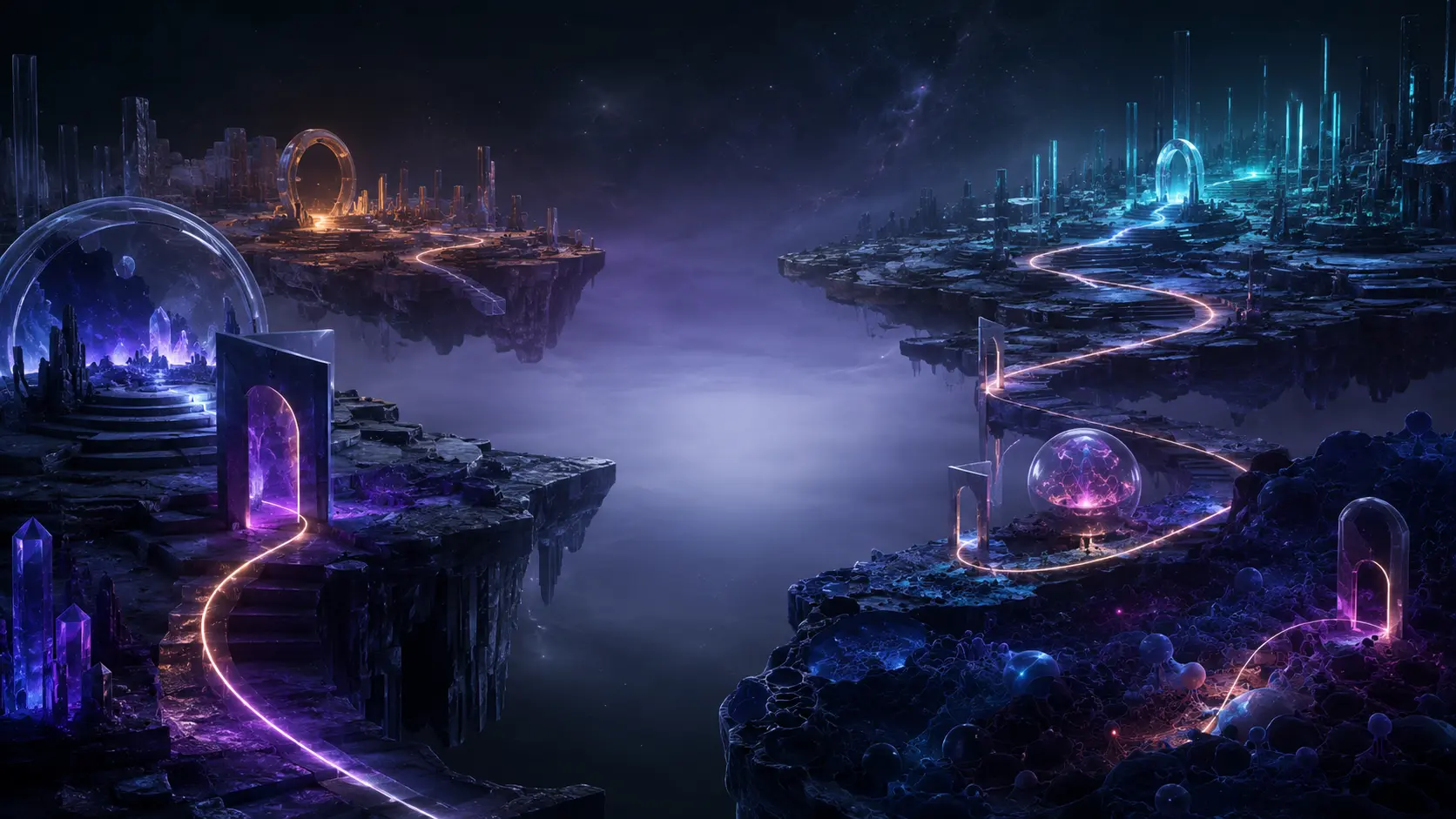
The render has given enough testimony
Nebula has an inconvenient advantage: it presents well. A luminous cave, several portals and a molecular route make the prototype appear to have answered questions that remain open. The image obtains attention before anyone checks whether a visitor can find a concept, remember a relation or return without negotiating with Escape.
The next step is therefore not a commercial cover or another demonstration corpus. It is a set of tasks that can fail. Nebula earns the right to continue when space improves a concrete cognitive operation: orientation in photosynthesis, following a mechanism, comparing scales or preserving the context of exploration. The fog may stay, but it loses the casting vote.
A demonstration dazzles. An experiment accepts measurement.
Find, explain and return head the specification
The first test is localisation: find a known entity without touring the universe out of pride. The second is understanding: reconstruct a relation or sequence after seeing it. The third is return: undo a detour without losing the starting point. The fourth is scale: move from region to component without the model changing language halfway through.
Performance is fifth because a territory that never appears is closed. Access is sixth: keyboard, touch, reduced motion, alternative text and a clear exit belong to the instrument, even while some spatial dimensions still need non-visual equivalents. Each test asks whether Nebula works outside the team that already knows its secrets.
One build must prove what it is for
Photosynthesis connects four scales, two causal routes and machines with concrete ports. The experiment must show whether that continuity helps people understand where light, electrons and protons go; flying over a thylakoid and leaving with a favourable opinion of magenta is not sufficient evidence.
There are already verifiable decisions: return history, intentional entry, labels conditioned by focus and distance, guided journeys, silent mode, keyboard and touch control, explicit WebGL failure states and resource release on exit. The whole exceeds a static mock-up. Its claim to be a general learning tool remains pending.
The scene may attract attention. The mechanism has to justify keeping it.
The editor and full accessibility have not clocked in
The corpus is still embedded in code. There is no world editor, data import, direct search, deep link to a position, persistent journey or public format for declaring relations. Those absences make testing external material expensive and keep the experiment dependent on a programmer.
A complete strategy is also missing for people who cannot or do not wish to navigate a three-dimensional scene. Reduced motion and keyboard support are useful requirements, not equivalents to an alternative graph or a synchronised linear reading. The prototype declares the limit instead of hiding it under a badge.
Free and experimental are specifications, not excuses
Nebula remains available without account or payment because its purpose is to explore and learn in public. Free entry reduces ceremony; it does not grant permission for broken routes, illegible controls or inflated claims. Every build must say what it does today, what it simplifies and what remains unmeasured.
The project keeps its possible scales, corpora and interactions open. It is not fixed as a commercial learning platform, a note map or a scientific simulator, although it may investigate parts of all three. The next phase will test the six questions against a real learning task. A useful result remains an experiment; a failed result remains evidence.
The future remains open. The test sheet does not.