EXPERIMENT · 05 RECORDS · PROVISIONAL FINDINGBY Arcotangana · PUBLISHED · REVISED
Nebula Photosynthesis: the leaf was too quiet to contain a factory
Nebula · Photosynthesis v0.10.0 links leaf, chloroplast and thylakoid through a continuous scale transition, and corrects PQ-9 and chlorophyll a with explicit chemical topology.
START READING ↓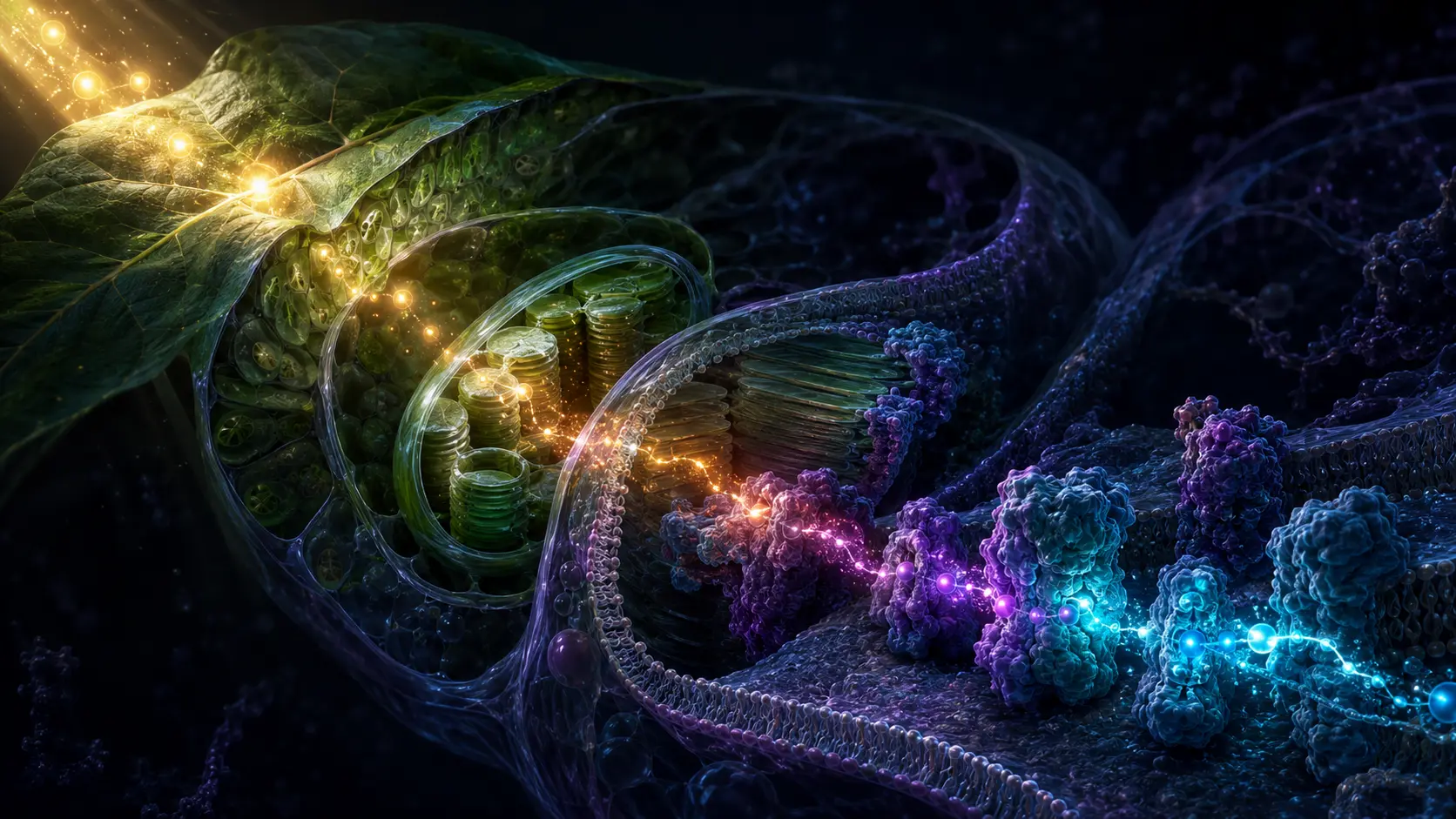
USABLE EXPERIMENT / THE THEORY HAS ALREADY CAUSED ENOUGH DAMAGE
The report ends.
Now enter.
WebGL · optional audio · keyboard, mouse and touch controlsThe list acquired a mechanism and lost its alibi
Nebula began by turning abstract relations into places that could be crossed. Photosynthesis now makes that spatial grammar answer to a concrete mechanism: light must reach an antenna, an electron must change carrier and a proton must find a machine that justifies its accumulation. The cosmic decoration keeps its job, but no longer chairs the meeting.
Version 0.10.0 is the only public Nebula build. It links leaf, chloroplast, thylakoid and molecular machinery in an experience that can be explored freely or followed as a causal sequence. It is neither a biophysical simulation nor a product waiting for a price: it is an experimental instrument, usable now and still willing to be corrected.
A node may declare a relation. A machine must show where matter passes.
From leaf to thylakoid without changing buildings
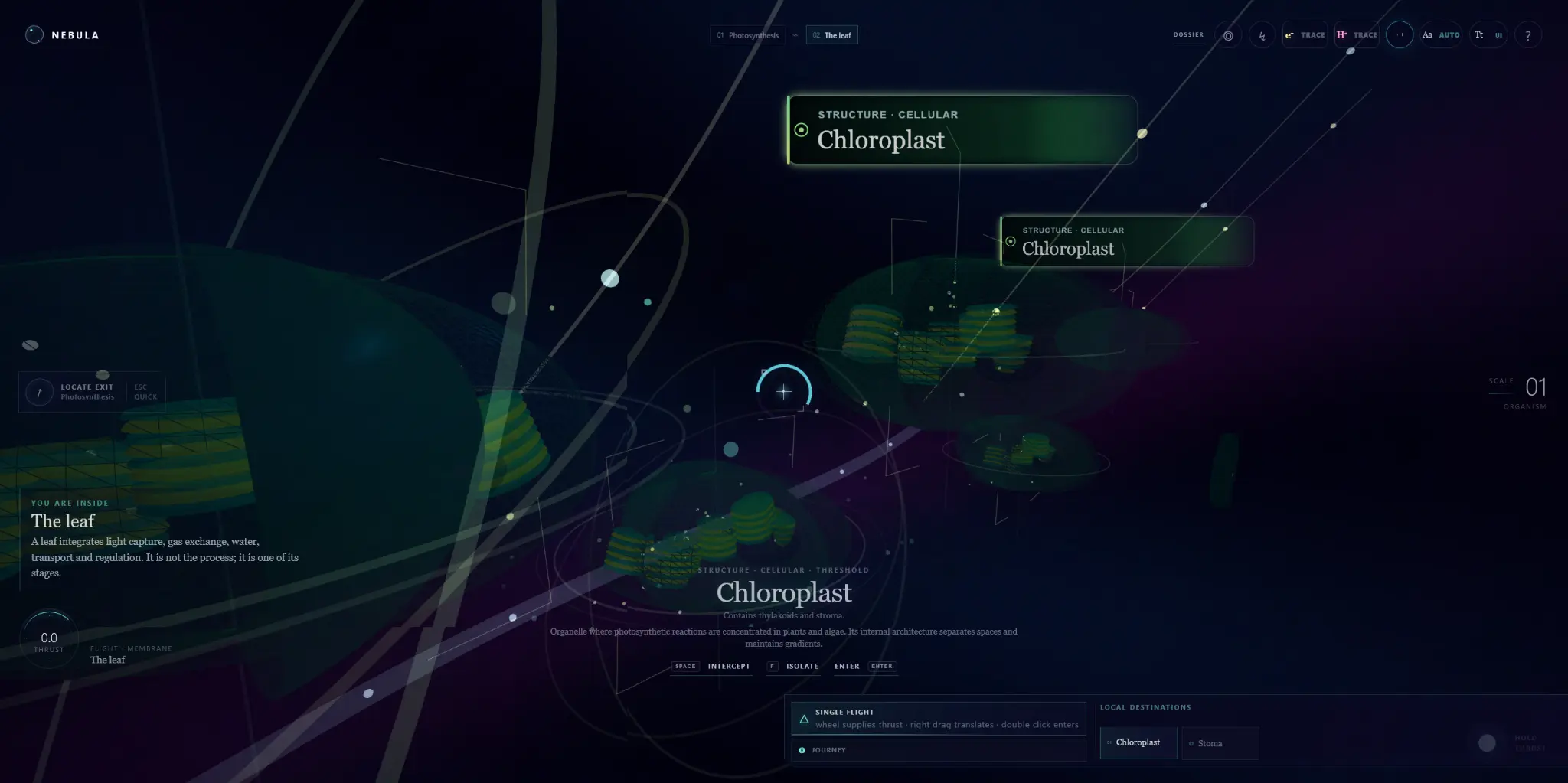
The journey begins inside a leaf with mesophyll, water, stomata and several chloroplasts. On approach, grana stop being a word and become navigable stacks; then the thylakoid membrane appears with lumen, bilayer and stroma as continuous regions. The camera does not load a different slide for each scale. It descends through an architecture that tries to preserve where things were before they became large.
That continuity requires label discipline. At distance, regions and machines remain; close up, carriers, cofactors and parts appear. Version 0.10.0 resolves collisions using projected size, fades labels when the camera invades their owner and reserves priority for focus and causal routes. Text stops behaving like a flock of number plates glued to the glass.
Nine stations so the electron can file a receipt
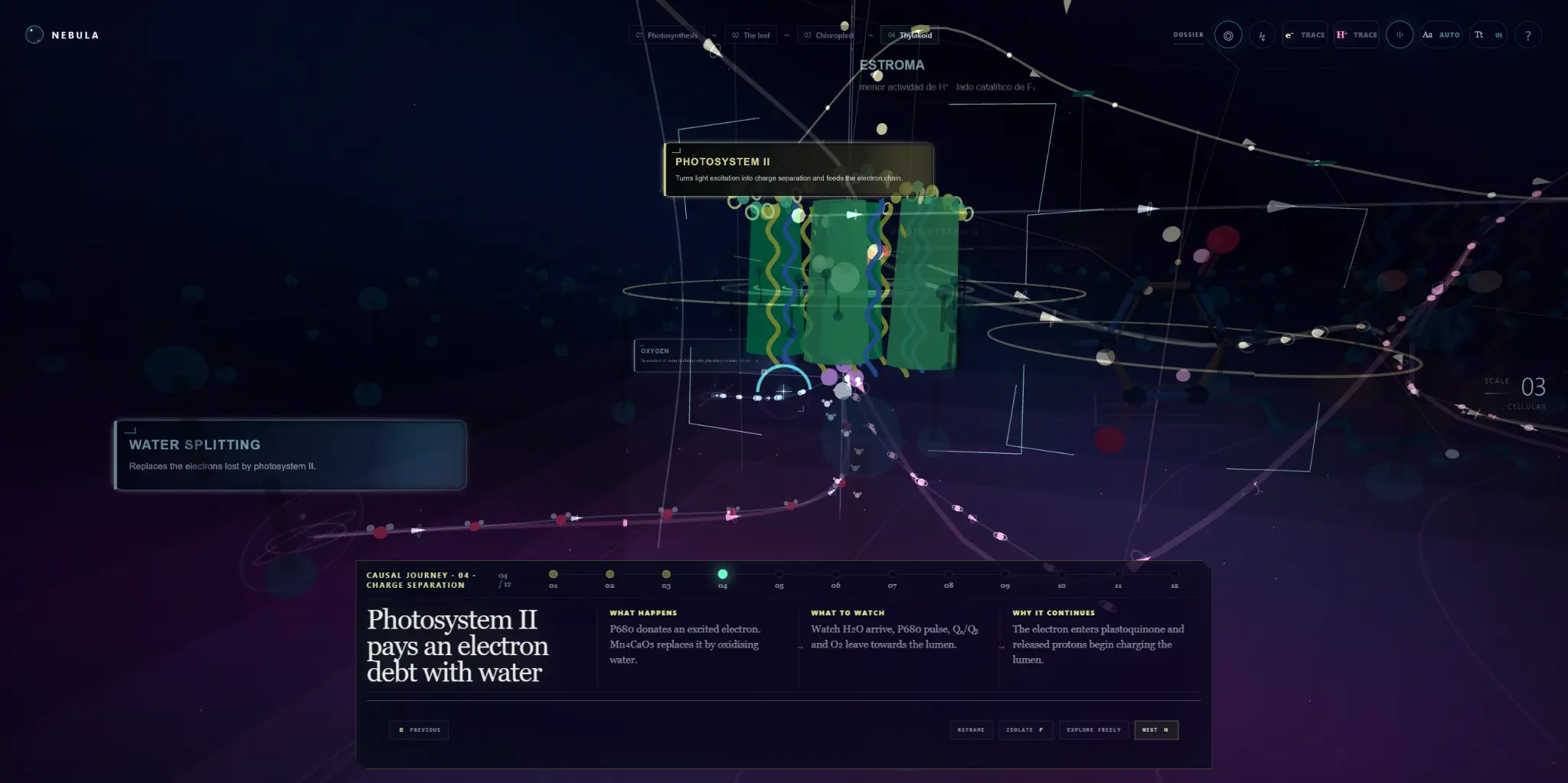
The laboratory orders a nine-station trace: photon, photosystem II, plastoquinone, cytochrome b₆f, plastocyanin, photosystem I, NADPH, gradient and ATP synthase. Each stop separates mechanism, observation and consequence. Routes dock at specific ports—water entry, oxygen exit, Qₒ and Qᵢ sites, ferredoxin and F₀ half-channels—so particles do not cross proteins by scenic decree.
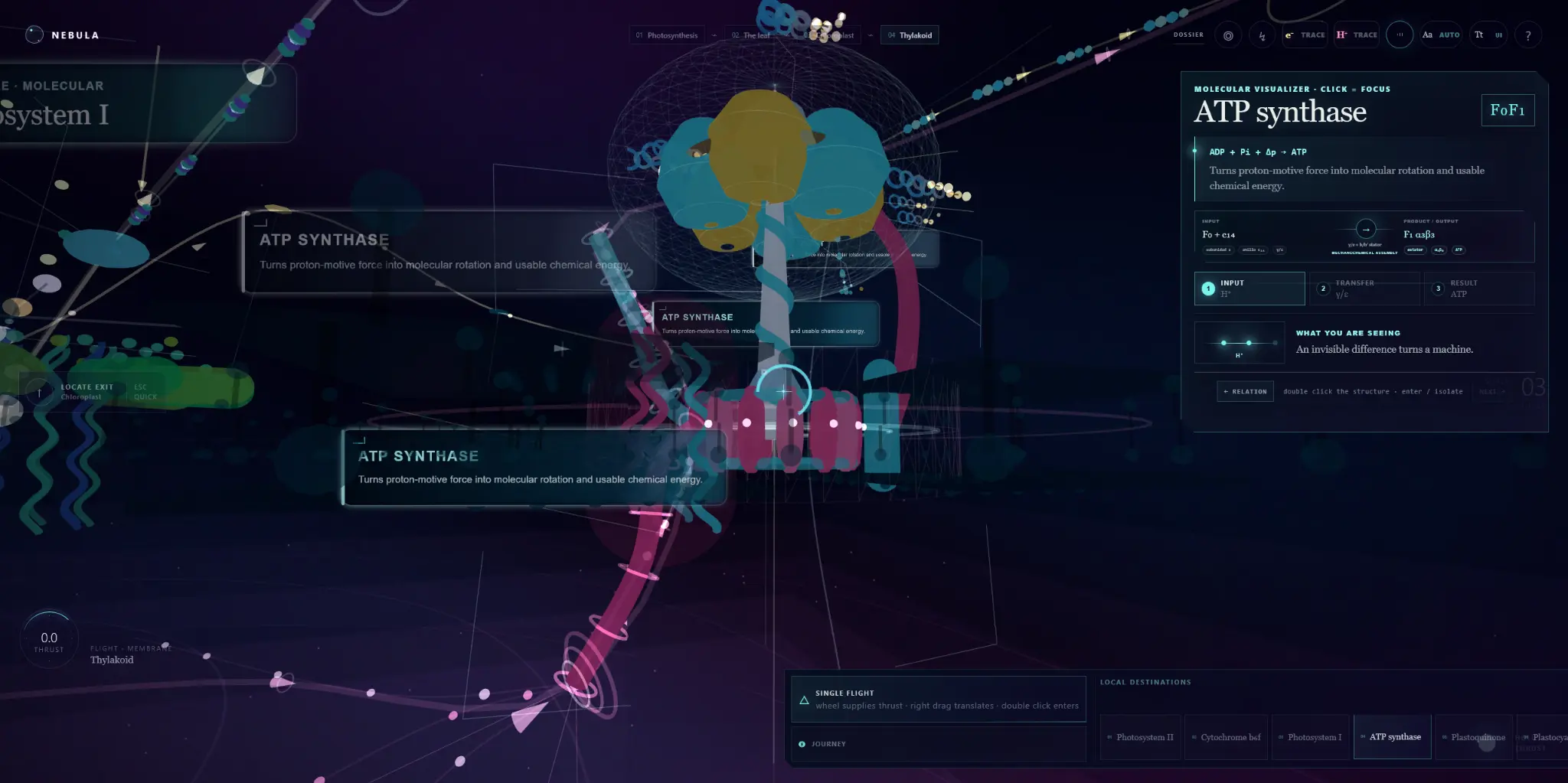
Plastoquinone exposes its quinone head, carbonyls, isoprenoid tail and redox state. ATP synthase exposes F₀, c-ring, γ/ε shaft, F₁ head, stator and catalytic sites; ADP and phosphate enter, the rotor transmits torque and ATP leaves. These are explanatory procedural models, not atomistic reconstructions. Geometry clarifies functional relations and retains the administrative duty to declare every simplification.
The arrow no longer points at a protein. It has to find the door.
The camera acquired laboratory manners
Free flight uses one grammar: left drag to look, right drag to translate, wheel to thrust, click to select and double click to enter or isolate. A fixed entity retains part of its context and accepts orbit, pan, dolly, zoom and pause. Nearby relations offer explicit exits, so inspection does not have to end with an administrative return to the beginning.
Two additional journeys separate carriers. `G` follows light and electron from the local sun to NADPH; `H` accompanies a proton from water oxidation, through the gradient and into ATP. `N` and `B` change station, `P` pauses and `Esc` restores the exploration point. The observation camera turns a pause into a tool: looking around no longer means missing the molecular bus.
A spatial explanation remains an interface hypothesis
The complexes represent architecture and causality, but do not replace experimental structures or a biophysical simulation. Proteins are not reconstructed atom by atom, particles are teaching signals and visible rhythms do not express molecular kinetics. The build tests whether a membrane can be read as a workplace rather than as a three-dimensional menu.
A technical debt also remains: Three.js produces a substantial experiment bundle and a larger corpus will require selective splitting. The next test is not more glow. It must measure whether someone can reconstruct the mechanism, distinguish what each route carries and return to an entity without relying on muscle memory.
A model explains a relation. It does not thereby acquire an electron microscope.