Change scale
From the leaf to molecular structures.
Free · No sign-up
An interactive journey from leaf to thylakoid
Enter a leaf, discover the chloroplast and follow how light energy sets a chain of processes in motion. Visit photosystems, follow electrons and protons, and explore the molecular structures involved in photosynthesis.
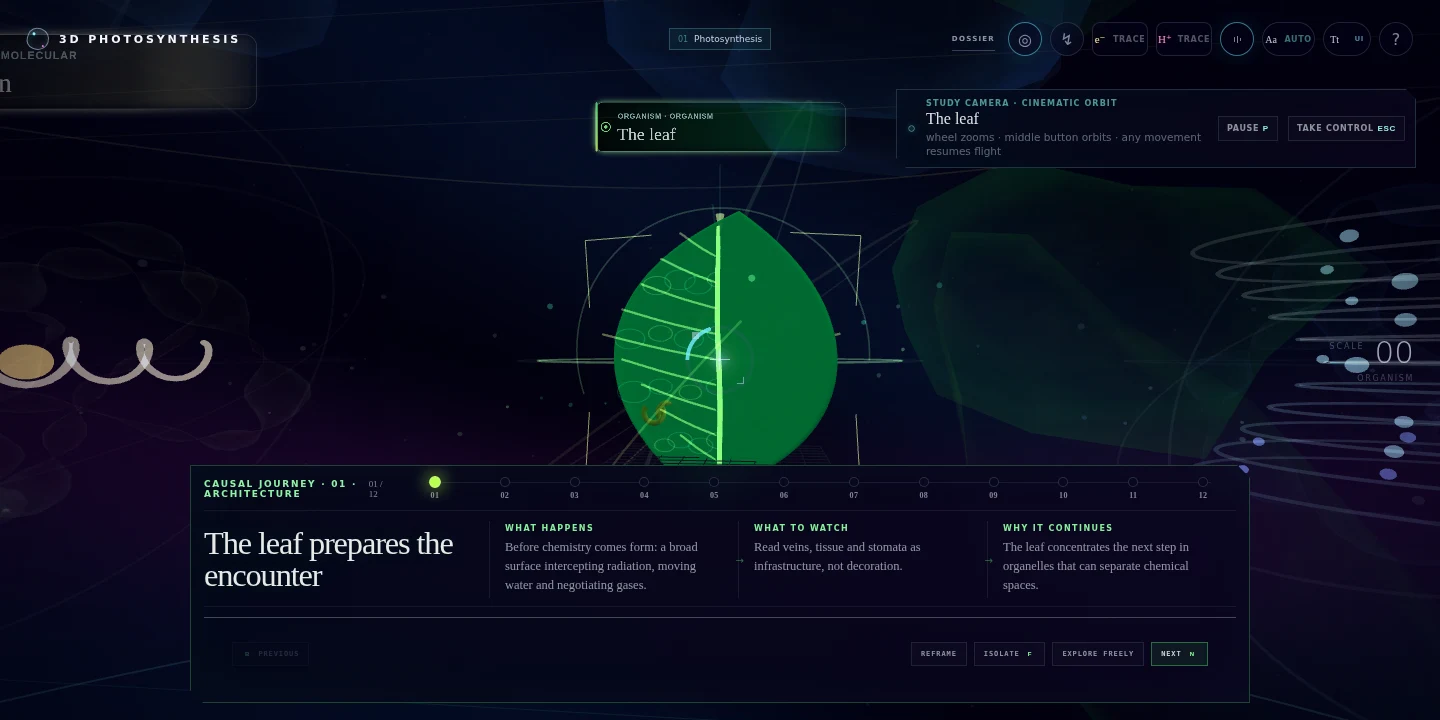
From the leaf to molecular structures.
Follow electron and proton routes.
Inspect structures and understand their relationships.
The leaf, chloroplast, thylakoid, light reactions and some of their molecular structures.
Yes. No payment or registration is required.
It is an interactive visual explorer for understanding structures and causal relationships. It does not replace a quantitative biochemical simulation.
A WebGL-compatible browser. Without WebGL, use the real captures below, the learning guide and the linked scientific dossiers.
01 / EVIDENCE OF EXISTENCE
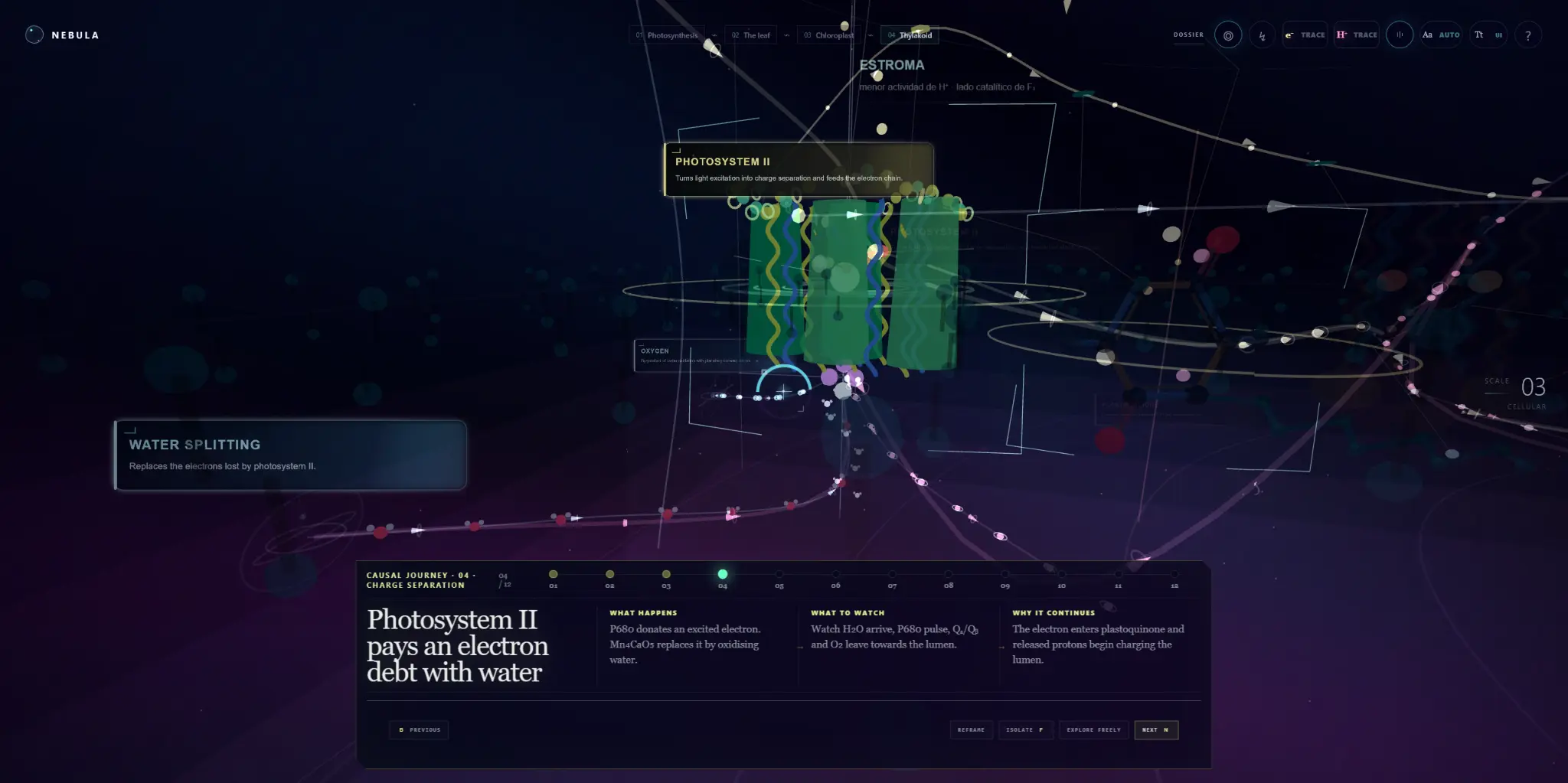
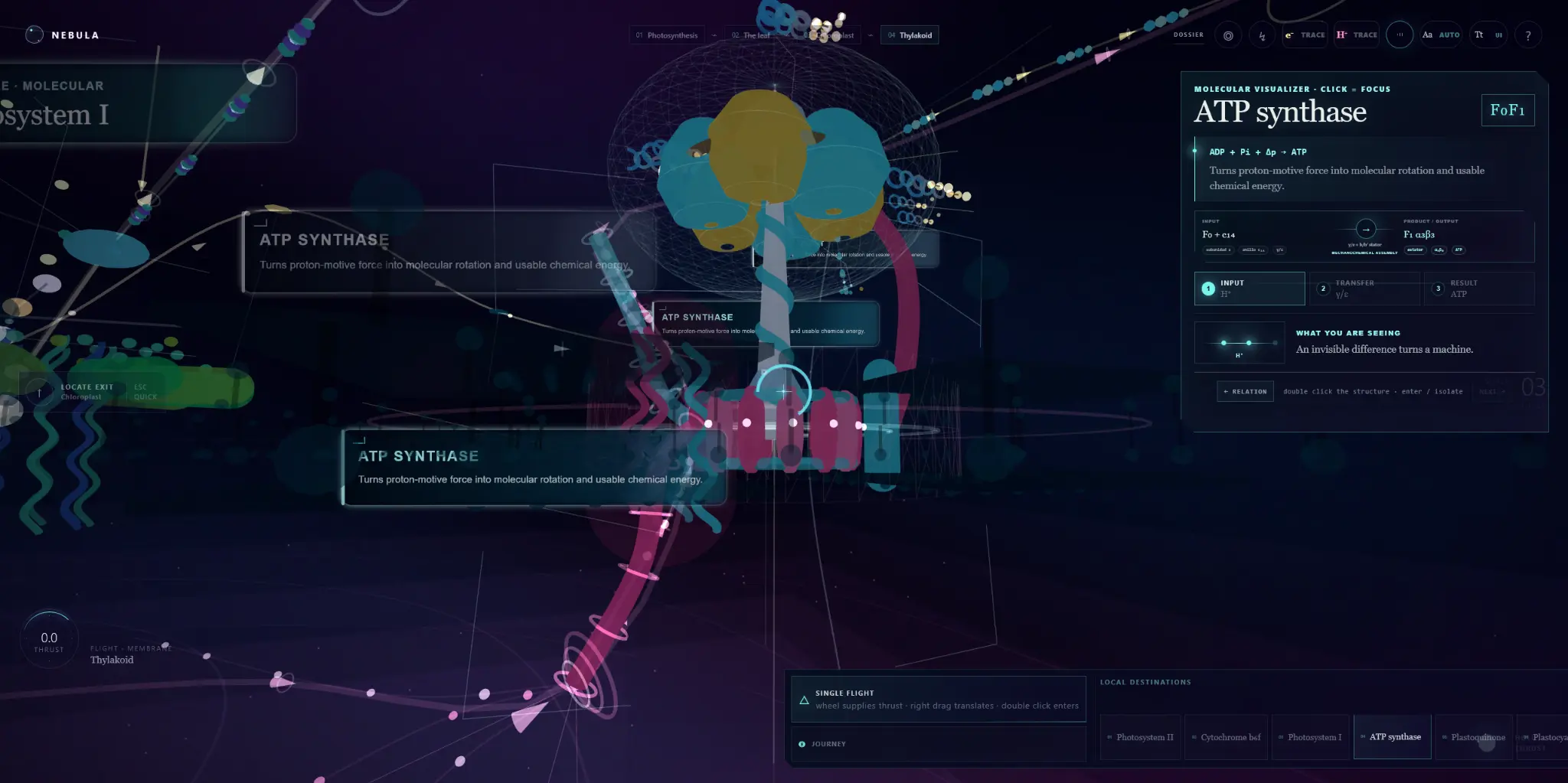
The first capture shows the current v0.11.0 experience, recorded on 4 November 2026. The molecular views are real historical captures from the 0.9.x series, dated individually below.
04 / OPEN NOTES FROM THE EXPERIMENT
Three dossiers document the photosynthesis microcosm, its orientation grammar and the six tests used to keep the experiment honest.
Nebula · Photosynthesis v0.10.0 links leaf, chloroplast and thylakoid through a continuous scale transition, and corrects PQ-9 and chlorophyll a with explicit chemical topology.
01 / READ ↗NEB—002 / 8 minA spatial interface fails when its visitor cannot tell where they are, why they arrived or how to undo the journey. Nebula treats those three questions as part of the content.
02 / READ ↗NEB—003 / 9 minThe prototype already knows how to impress. Search, understanding, return, scale, performance and access now have to prove that the experiment teaches more than its fog suggests.
03 / READ ↗CLASSROOM / SELF STUDY
Suggested activity for upper-secondary biology and introductory university courses. Allow 20–30 minutes after studying chloroplasts and redox reactions. This is a teaching proposal, not a validated curriculum resource.
Follow the electron journey from water oxidation at photosystem II through cytochrome b₆f and photosystem I towards NADPH. Light supplies energy at both photosystems; the electron and proton routes are not interchangeable.
TASK: Locate PSII and PSI. Where does the electron come from, and what receives it at the end?
EXPLORE IN 3D ↗Compare the stroma and thylakoid lumen. Proton accumulation in the lumen helps drive ATP synthesis as protons return through ATP synthase. Visible particles and speeds explain relationships, not measured kinetics.
TASK: Follow the proton route. On which side do protons accumulate, and through which complex do they return?
EXPLORE IN 3D ↗Inspect PSII, cytochrome b₆f, PSI and ATP synthase at a shared scale. The atlas uses experimental PDB structures; its simplified representations are distinct from the explanatory scene.
TASK: Compare two complexes and record their PDB identifiers. What can their shapes show, and what cannot be inferred from a static structure?
OPEN THE ATLAS ↗Use a browser with WebGL and test your classroom devices first. Audio is optional. The landing and dossiers remain readable without loading the 3D engine; a complete non-visual equivalent is still pending.
This build focuses on the light-dependent reactions. It does not offer an interactive Calvin cycle, SCORM packages or LTI integration. For Moodle, Canvas or Blackboard, add a link to this page; external iframe embedding is currently blocked.
Finish by drawing the electron and proton routes separately, marking lumen and stroma, and noting two limits of the model. Check your explanation against the sources in the dossier.
LIMITS / READ BEFORE EXPLORING
This explorer is not seeking accounts, subscriptions or manufactured retention. Its purpose is to make one mechanism easier to inspect and to learn from the attempt.
Try the experiment, inspect the notes or follow its code and later work on GitHub.
ENTER WITHOUT AN ACCOUNT ↗GITHUB / CORIUMALPHA ↗